
To understand well-being at work we need to understand emotional labour. “Emotional labour” refers to a specific, critical labour process. It can be understood as the management (e.g., inducing, suppressing, redirecting) of emotions to perform a demeanour of professionalism that is appropriate for a specific working context. This is a performance, because every worker will be carrying out their tasks within social and organisational contexts that form expectations around how they act while working. Yet, while emotional labour can be an enjoyable labour process, it is not always aligned with how a worker actually feels.
For example, a waiter may perform a professional demeanour of friendliness and patience while taking someone’s order, despite actually feeling deeply frustrated by the interaction. Short moments of dissonance between how someone feels and how they are expected to behave in a professional context are normal and, in most instances, unavoidable. However, when this kind of dissonance persists regularly, it can detrimentally impact well-being in a range of ways, including burnout (e.g., Riforgiate et al., 2021). If emotional labour plays a role in shaping the well-being of human workers, we should critically question how it impacts workers of other species, too.
Challenging decades of anthropocentric perspectives in emotional labour literature, recent discourse is raising awareness of emotional labour performed by individuals of other species. In Animal Organization Studies, scholars are considering emotional labour performed within “humane jobs” (Coulter 2016, 2019, 2020; Warda, 2022) and specifically performed by, for example, horses working in tourism (Dashper, 2019), dogs working in customs (Paul, 2024), or guide dogs and their trainers (Warda, 2023, 2025, 2026).
Recently, some of Dr Tiamat Warda’s (PAWWS, University of Lapland) work was published from her research on interspecies emotional labour prior to joining the PAWWS team.
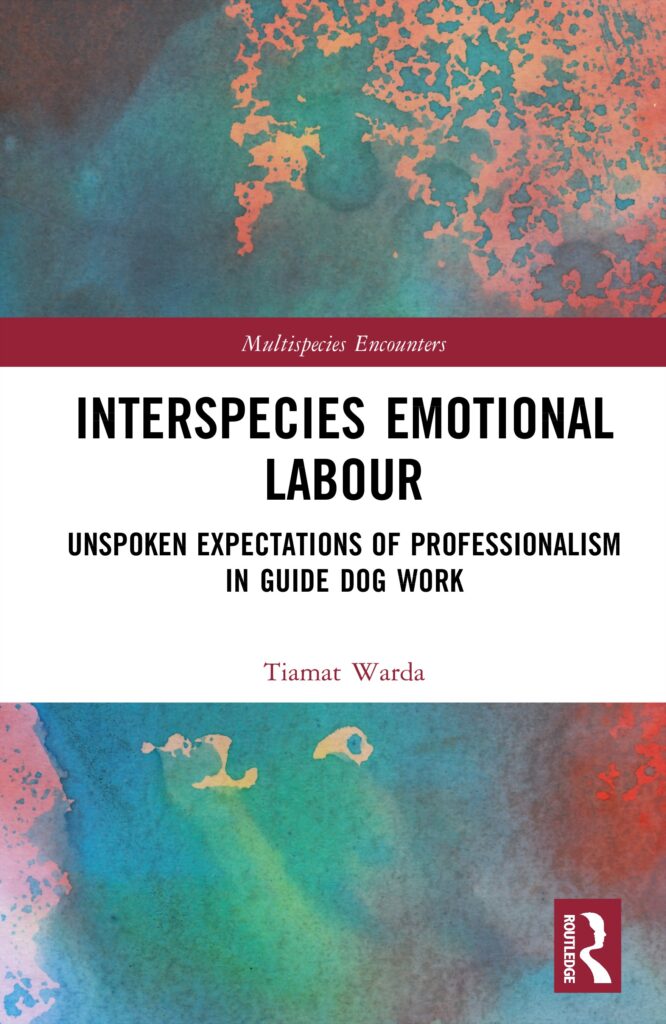
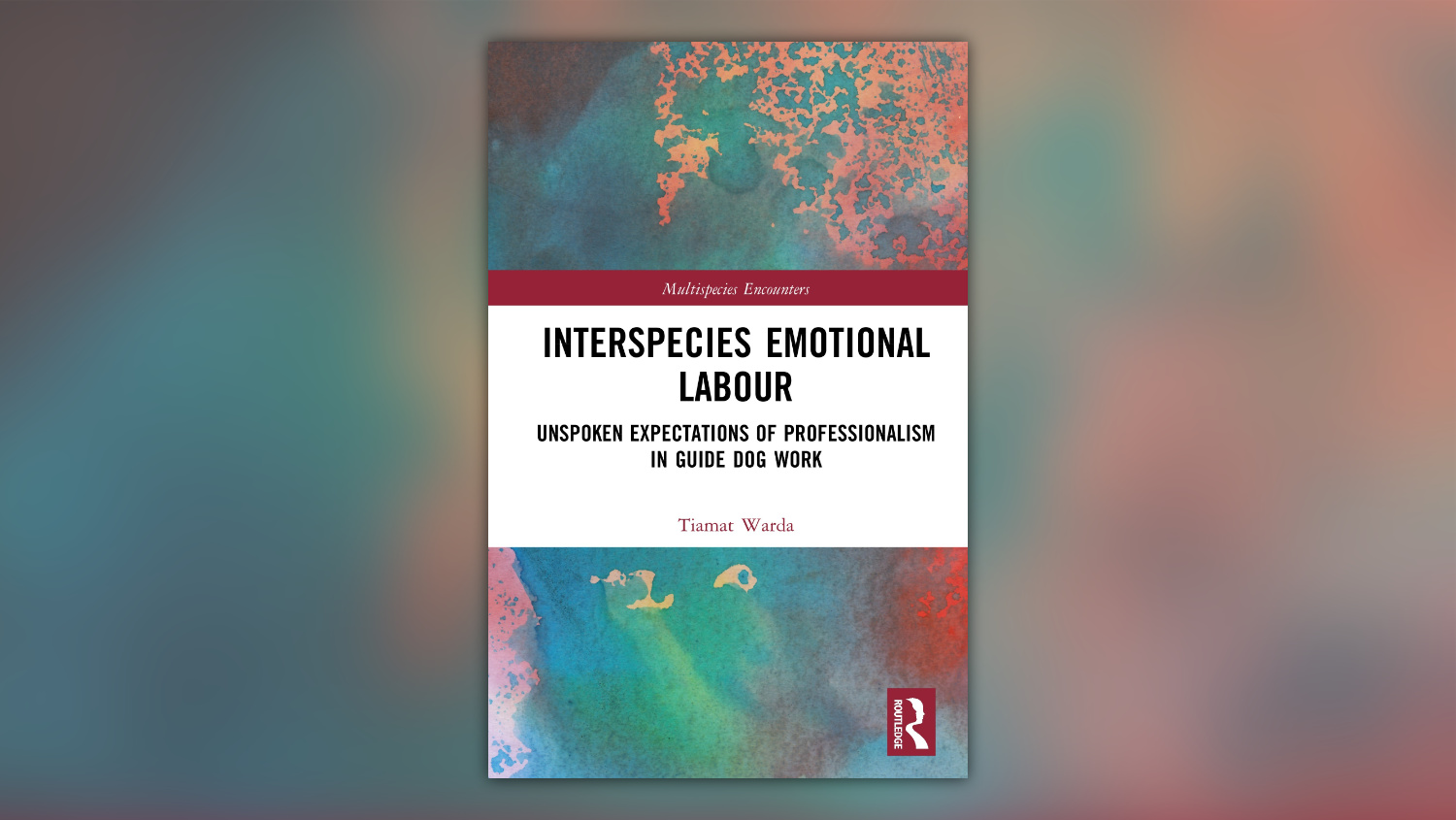
Based on her doctoral research in the UK, at the University of Exeter, Tiamat’s recent monograph, “Interspecies Emotional Labour: Unspoken Expectations of Professionalism in Guide Dog Work”, was published in Routledge’s Multispecies Encounters series in December 2025. This monograph thoroughly articulates the concept of “interspecies emotional labour”, with guide dogs and their trainers/instructors as case studies.
With Tiamat’s training as an anthrozoologist and current discipline of Animal Organization Studies, this monograph takes an interdisciplinary approach to understand how interspecies emotional labour is shaped and managed within organisational processes. It argues that emotional labour performances, in particular how a worker performs emotional labour (i.e., the aforementioned induction, suppression, or redirection of emotions – in other words the strategies they utilize) impacts both work quality and worker well-being. Throughout, Tiamat’s own professional experience working with guide dogs is met with those of the participants – professionals in the guide dog sector – and woven together with extensive theoretical discussion from a range of disciplines. In this way, while it remains an academic text that will be of interest for academics researching interspecies work, it has high relevance for practitioners, as well. If you’re interested in learning more about this monograph, you can find it here.
Also in December 2025, based on prior research but aligned with her work at PAWWS, Tiamat published an article in the International Journal of Work Organisation and Emotion that extends the interspecies emotional labour discussion further, entitled “Harnessing emotion: the haptic and acoustic professionalism of guide dogs”. Here, the focus on interspecies emotional labour is placed specifically on acoustic and haptic (i.e., concerning the sense of touch) interpretations of its performances. For example, a guide dog may appear calm to an observer, but the person they are guiding may feel tension in the harness and, therefore, conclude that the dog may actually be feeling stressed, excited, or anxious.
In this way, the guide dog was successful in performing emotional labour to present a professional demeanour that is visually appreciated, while suppressing their emotions to carry out tasks correctly, but their true emotional state can be felt through this tension. This can also be heard by, for example, their panting (or lack thereof) and how quickly or slowly their paws are landing as they guide someone. This article unpacks this idea at length, and highlights the importance of considering this not only as we think about emotional labour performed by other species, but emotional labour performed for visually impaired or blind individuals. The article can be found here, but feel free to contact Tiamat directly if you do not have access to the PDF.
Such publications support PAWWS’ wider aim of understanding multispecies well-being at work. They provide academics and practitioners with concepts and terminology to develop a more nuanced understanding of professionalism that can be used to improve interspecies emotional labour-relevant organising. In this way, they can provide a useful lens for PAWWS and related research concerning ethical, sustainable multispecies workplaces.
References
Coulter, K. (2016). Animals, Work, and the Promise of Interspecies Solidarity. Palgrave Macmillan, New York, NY.
Coulter, K. (2020). Toward Humane Jobs and Work-Lives for Animals. In C.E. Blattner, K., Coulter, & W., Kymlicka (Eds.), Animal Labour: A New Frontier of Interspecies Justice? (pp. 29–48). Oxford University Press. https://doi.org/10.1093/oso/9780198846192.001.0001
Coulter, K. (2019). Horses’ labour and work-lives New intellectual and ethical directions. In J., Bornemark, P.,Andersson, & U.E. von Essen (Eds.), Equine Cultures in Transition (pp. 17–31). Routledge.
Dashper, K. (2019). More‐than‐human emotions: Multispecies emotional labour in the tourism industry. Gender, Work & Organization, 27(1), 24-40. https://doi.org/10.1111/gwao.12344
Paul, B. (2024). (In) tangible Teamwork: Human Perception of Nonhuman Sensing in the Case of Human-Sniffer Dog Ensembles. Humanimalia, 15(1), 75-104. https://orcid.org/0000-0003-3786-2707
Riforgiate, S. E., Howes, S. S., & Simmons, M. J. (2021). The Impact of Daily Emotional Labor on Health and Well-Being. Management Communication Quarterly, 36(3), 391-417. https://doi.org/10.1177/08933189211041352
Warda, T. (2023). Emotions at Work: Acknowledging interspecies emotional labour of guide dog mobility instructors. Society & Animals, 33(1), 1–19. https://doi.org/10.1163/15685306-bja10125
Warda, T. (2022). Interspecies Emotion Management: The importance of distinguishing between emotion work and emotional labour. TRACE .:. Journal for Human-Animal Studies 8, 82–101. https://doi.org/10.23984/fjhas.111345
Warda, T. (2025). Harnessing emotion: the haptic and acoustic professionalism of guide dogs. International Journal of Work Organisation and Emotion, 16(4), 400-420. https://doi.org/10.1504/IJWOE.2025.150228
Warda, T. (2026). Interspecies Emotional Labour: Unspoken Expectations of Professionalism in Guide Dog Work. Routledge.
Authors
Tiamat Warda, Postdoctoral Researcher, University of Lapland