
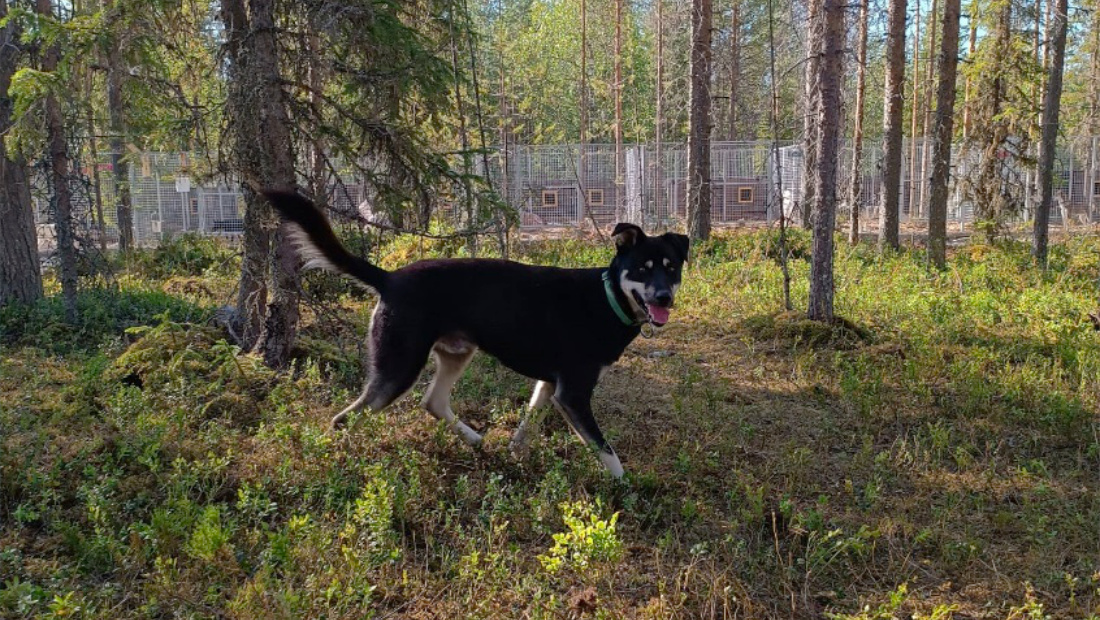
One of the dogs who didn’t enjoy the old free run before is super happy about the new one. The old one was a small one between the kennel rows, with all the dogs being super close to each other. Now in the new one, which is set up in a U shape, there is more space between the kennels and the free run, and he really likes it. It’s nice to see how some dogs change because of a better and calmer free run area.
14.07.2025, Company 2, new dog yard
This is one of my diary entries I wrote down as data for my master’s thesis. I work with sled dogs since October 2020, the reason why I decided to do my thesis about animal welfare and wellbeing of sled dogs based on my experiences and knowledge. During my studies, I worked at two different tourism husky farms, one during wintertime and at the second one during summertime. At both places, I wrote down observations and informal conversations I had with colleagues with the focus on aspects and factors impacting the dogs’ welfare and wellbeing. In total, I wrote down 149 diary entries of my workdays.
Especially over the last years, more and more incidents and bad cases of the sled dog industry were made public in newspapers and on social media. The awareness of the sled dogs’ welfare and wellbeing is increasing and along with it the awareness of lacking such. In addition, the interest of scholars and researchers into the topic experiences an increase too (see Winter, 2020). However, most research is done from an outsider perspective, lacking insider knowledge and access. This is where my previous experience and access to the industry is being helpful and crucial for exploring animal welfare and wellbeing.
Because my research is based on my own experiences and observations, also called an autoethnography, one of the main influencing factors are the relationships between me, other human workers and the dogs. Previous research already suggests that animal welfare and wellbeing is strongly linked to the human-animal relationships (see Hoarau-Heemstra & Kline, 2022; Coulter, 2016).
During the analysis of my data, I chose three factors influencing the dogs’ welfare and wellbeing. Those are feeding, the dog yard/ kennel layout, and the dogs love for running.
Key Findings
Feeding
The goal of our feeding system is to open the door, put the empty bowls inside, while the dogs wait inside without jumping out. Once we start filling soup in the bowls, the dogs are not allowed to touch them anymore. Then we add dry food, and when all bowls are ready, we move them a bit away from each other but still keep them closer. When we say the name of the dog, they are allowed to start eating. This way, the dogs learn that even when there is food around, and they are eating close to each other, not to steal and leave others alone. Besides that, after running when they get their food in line, they have to eat close to other dogs. Of course, some dogs never learn not to steal, but those are known, and we need to watch them. But the majority is really good with the food around.
07.01.2026, Company 2, reflections about feeding practices
Feeding is one of the main factors influencing animal welfare and wellbeing. Over the years, I saw many different approaches and practices about feeding the dogs, depending on their living situation. Most kennels just put the food bowls inside the dog kennels; others have feeding holes where the dog needs to put their head through a hole in the fence to reach the bowl with food. Both practices have their advantages, feeding holes are the faster feeding practice for humans, while feeding the dogs with their bowls in their kennels provides more chances to teach the dogs how to behave around food and improves the dogs’ social skills around other dogs.
In addition to the feedings, offering snacks during the day, for example, during playtime also adds to teaching the dogs’ social skills around food and other dogs. The main goal here is, to create a relaxed environment for the dogs. Therefore, feeding is about much more than just the nutrients of the food, the quantity and quality of it, and how often the dogs eat. Adjusting feeding practices in a way to include teaching social skills is beneficial for the dogs.
In previous studies about animal welfare, feeding is often about the practice of providing the right quality and quantity (Bohn et al., 2018; Fennell & Markwell, 2015), without taking into account how feeding can be used for teaching social skills.
Kennel Layout
Compared to the wintertime when there are guests and sledding happening, there is not that much happening here at the moment. Usually, kennel days are quite calm and relaxed, as are the dogs, and they enjoy their daily play and free running time. I think having this is rather rare among tourism husky kennels as it requires more employees, and most kennels are not set up in a way to make this easily possible. But it is definitely something that makes the dogs happy and keeps the energy level low during summertime.
24.05.2025, Company 2, Daily free running time
The kennel layout can either be an advantage for daily practices or limiting those. Most kennels are set up in a similar way, with the kennels being close to the start area for training and tours, and a fenced area for playtime and free run somewhere at the outer side of the farm area. However, dividing all dogs into separate dog yards, which include fenced free run areas, offers the opportunity for each dog to enjoy daily playtime every day of the year. Especially for bigger kennels, with many dogs, having several fenced play areas is an advantage for the dogs. Having several play areas and including daily playtime in work routines also requires more human workers, especially during summertime but also all-year round, which can be seen as a downside from a business perspective. Husky Farms need to generate the yearly income within a short winter season (Hoarau-Heemstra & Kline, 2022). Therefore, financial
decisions are often guiding factors such as kennel layout and the number of human workers all-year round and having more workers during summertime is often dependent on the financial situation of the kennel.
Previous studies about animal welfare and wellbeing do not often focus on the kennel set up. One study, by Bohn et al., (2018), focuses on dog houses, living conditions and kennel structures in their work, besides other factors. Also, the Finnish Food Authority (2025), does not offer direct guidelines and recommendations for husky farm setups, but rather general recommendations such as having a play area.
Running
I learned that the whole dog yard is divided into five teams, with always four running. In my calculation, this means they have four days running, one day off and so on. I am wondering if the performance difference, therefore, is not just because of the breeding line difference, but also because of the rest days. Or maybe also because the dogs here do not get to see anything else, while our dogs get swapped out with the main farm’s dogs regularly to see other trails and tours.
19.01.2025, Company 2, charter rides main company
For the last topic of my analysis, I focused on factors which influence the dogs’ motivation and love for running. Based on my observations and data, especially the tour length and variety have a strong impact on the dogs’ love for running. Short and repetitive runs are the toughest runs for the dogs and can result in lower motivation to run. However, besides the tours, the management and number of regular rest days is also important and has a great impact on the dogs’ performance. The Finnish Food Authority (2025), does not state directly how many rest days per week a dog should have. Therefore, managing the running days and off days is up to each husky farm to decide themselves. In addition, there are also different ways and practices to prevent injuries for dogs. Some farms offer daily free run time to the dogs to stretch their legs while others provide the dogs with massages.
Here again, financial outcome is often the main reason for husky farms to choose and offer short repetitive tours, as they generate the highest money income. That means, that especially for those tours, the relationships between humans and animals have a strong impact on the dogs’ welfare and wellbeing, as the workers observe the dogs and are the ones that make decisions.
Conclusion
In previous research, models for identifying and assessing animal welfare and wellbeing do not take human-animal relationships into account as a strong influence (see Mellor et al., 2020). However, this study shows how important the human-animal relationships are when taking a look at animal welfare and wellbeing.
For feeding, it is crucial for the workers to know each dog, not just for the right amount of food, but also about their social skills around food. Besides that, feeding and giving snacks can be used to improve the dogs’ social skills which is done by workers using feeding routines which support those learning opportunities for the dogs.
The farm and dog yard setup is also based on humans making decisions about what to focus on. For a dog-centred layout, including daily play and free run time can mean to build more fenced area and to make those part of the dog yards. In addition, including daily play time requires more workers and also each worker to know the dogs’ characters.
Last, the dogs’ love for running and motivation is often dependent on the running schedule with regular days off, as well as it is dependent on the trail and tour variety. Both are factors which are decided by humans and created by those. Here, including the dogs’ needs is crucial for improving their wellbeing and welfare regarding the tours and running. Besides that, when working with the dogs, every worker needs to know each dogs’ ability and limitations to not overwork the dogs.
The full master’s thesis “Exploring Animal Welfare and Wellbeing of Working Sled Dogs through Autoethnography” will be published in Lauda during summer 2026.
Author
Helena Eichner
Master’s Degree student
Tourism, Culture and International Management (TourCIM)
University of Lapland
References
Bohn, D. J., García-Rosell, J., Äijälä, M. (2018). ANIMAL-BASED TOURISM SERVICES IN LAPLAND.
Coulter, K. (2016). The Work Done With/For Animals: Daily Work and Labor Processes. In Animals, Work, and the Promise of Interspecies Solidarity (pp. 21-54) (1st ed. 2016.). Palgrave Macmillan US. https://doi.org/10.1057/9781137558800
Fennell, D. A., & Markwell, K. (2015). The Status of Animal Ethics Research in Tourism: A Review of Theory. Bristol, Blue Ridge Summit: Channel View Publications. https://doi.org/10.21832/9781845415051-006
Finnish Food Authority. (2025). Koirien pitoa koskevia uusia vaatimuksia. Finnish Food Authority. Retrieved January 29, 2026, at 14:37, from https://www.ruokavirasto.fi/elaimet/elainten-hyvinvointi/elainsuojelu-pitopaikoissa/harrastus- -ja-lemmikkielaimet/koirat-ja-kissat/koirien-pitoa-koskevia-uusia-vaatimuksia/
Hoarau-Heemstra, H., & Kline, C. (2022). Making kin and making sense of human-animal relations in tourism. Ecological economics, 196, 107396. https://doi.org/10.1016/j.ecolecon.2022.107396
Mellor, D. J., Beausoleil, N. J., Littlewood, K. E., McLean, A. N., McGreevy, P. D., Jones, B., & Wilkins, C. (2020). The 2020 Five Domains Model: Including Human–Animal Interactions in Assessments of Animal Welfare. Animals (Basel), 10(10), 1870. https://doi.org/10.3390/ani10101870
Winter, C. (2020). A review of research into animal ethics in tourism: Launching the annals of tourism research curated collection on animal ethics in tourism. Annals of tourism research, 84, 102989. https://doi.org/10.1016/j.annals.2020.102989